
Odysseus, Dante and the Masculine Mission
How to chase greatness without damning yourself

Most men today live like permanent Lotus-Eaters: drifting, numbed by entertainment, vaguely annoyed that life isn’t epic while doing nothing that would make it so.
Homer already wrote the antidote.
The Odyssey isn’t just an old poem about monsters and shipwrecks. It’s a manual on male mission, sexual temptation, leadership under pressure, and the cost of coming home late.
But it’s only a partial manual.
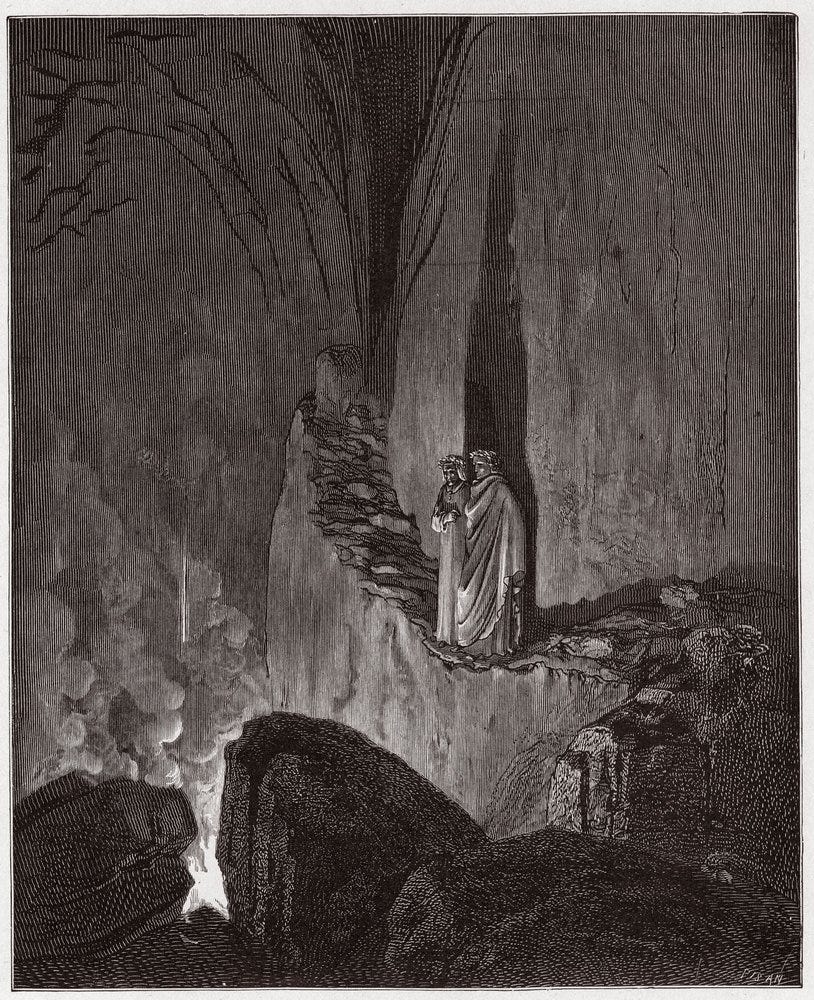
Dante, writing as a Christian, looks at the same Odysseus (Ulisse) and – crucially – puts him in a much deeper circle of Hell than Achilles.
Achilles, the all-time war hero, goes to Circle 2: Lust.
Odysseus goes to Circle 8, pouch 8: Fraudulent Counsel – deep in Malebolge, among those who abused their intellect for deceit and godless ambition.
In Dante’s moral universe, misusing your mind and leadership for fraud is far worse than being dragged by passion into fornication.
So: Odysseus shows you how a man fights, thinks and endures. Dante shows you where that same man ends if he makes his intellect, his projects and his ambition his god.
You need both lenses to read Odysseus like a Christian.
Homer gives you the hero.
Dante gives you the judgment on the hero.
Without Homer, you don’t see how high nature can rise.
Without Dante, you don’t see how far even a great man can fall.
Let’s walk through both.
Homer’s Odysseus: mission, monsters and masculine grit
At the start of the Odyssey, Odysseus isn’t drifting.
He has a clear mission:
get his men home,
get himself back to Ithaca,
reclaim his house,
restore order,
and see his wife and son again.
And Homer shows him facing exactly the things that wreck modern men.
a) The Lotus-Eaters – comfort as anaesthetic
Some of his crew eat the lotus and lose the will to go home. They don’t die. They just… don’t care anymore.
“They forgot their homes, and did not want to return…”
That’s most men now:
Porn instead of pursuit
Netflix instead of battle
Gaming instead of responsibility
Odysseus doesn’t negotiate with this. He drags his men back to the ships by force and sails away.
A man on mission refuses to live in the fog, even when people he loves are happy in it.
b) Circe & Calypso – pleasure as prison
Odysseus meets Circe, who turns men into animals. He stays a year in her bed.
He’s trapped again with Calypso, a goddess who offers him something every ageing man secretly wants:
permanent pleasure,
no responsibility,
and even immortality – on the condition he stays with her and never returns home.
He still chooses to leave, knowing he’s sailing back into danger, effort and the wear and tear of time.
Modern version?
Affairs.
OnlyFans.
“I’ll never marry, I’ll just enjoy myself.”
Or married men who are mentally still on Calypso’s island, living for screens and side pleasures instead of their own homes.
Homer’s message is brutal:
pleasure without purpose turns you into a slave.
Real masculinity is not “how much can I enjoy?” but “what am I willing to suffer for?”
c) The Sirens – weaponised attention
The Sirens promise knowledge and admiration:
“Never yet has any man rowed past this place… until he has heard the honey-sweet voice from our lips.”
They don’t just offer sex. They offer attention and validation – exactly what social media weaponises now.
Odysseus wants to hear them but knows they’ll destroy him, so he:
stops up his crew’s ears,
has himself tied to the mast,
and orders them not to untie him no matter how he screams.
He doesn’t trust himself. He trusts discipline, rules, and other men to hold the line for him.
That’s a Christian lesson before Christ:
if you play chicken with your temptations, you lose.
Dante’s Odysseus: when “mission” becomes damnation
If we only had Homer, we’d walk away thinking:
“Odysseus is the model. Copy him. Full stop.”
Dante honours Odysseus’s greatness – he gives him one of the most powerful speeches in the Inferno – but then puts him far below Achilles.
Why?
Because Dante isn’t just judging Odysseus as a warrior or a leader. He’s judging him as a man before God.
Achilles vs. Odysseus: passion vs. perverted intellect
Achilles dies for lust and rage. In Dante he’s blown about by a storm among the lustful. It’s weakness and passion.
Odysseus dies for fraudulent counsel – using his intelligence to deceive (Trojan Horse, etc.) and to drag his men into a godless, suicidal voyage.
Dante is making a hard ranking most men don’t want to hear:
Sex sin is serious.
Using your mind and leadership to lead others away from God is worse.
Lust is the fall of many men.
But pride + intellect + leadership = a deeper circle of Hell.
That’s why so many “high-IQ” men are in more danger than they think. Their temptations are more subtle, more “noble”-sounding, and often applauded by the world.
Dante’s invented ending: the forbidden voyage
Homer ends with Odysseus back in Ithaca.
Dante asks: what if this man, restless as he is, didn’t stay home?
So he has Ulisse tell how, after returning, he grew bored of domestic life, abandoned Ithaca, his aging father, his wife and son, and sailed out beyond the Pillars of Hercules – the edge of the known world, a boundary God had set.
He rouses his men with a speech that sounds heroic:
“Consider your origin:
you were not made to live like brutes
but to follow virtue and knowledge.”
If you only half-listen, it sounds like a self-improvement poster.
But in Dante’s frame, it’s deadly:
He appeals to “virtue and knowledge” against the will of God.
He leads his men away from their duties, families and vocations in the name of a “higher” quest.
He sails into waters explicitly forbidden.
This isn’t studiousness. It’s curiositas in the classic Christian sense: disordered hunger for experience and knowledge outside the path God has given you.
So God answers not with applause, but with a whirlpool.
The ship goes down.
The men die.
The great quest ends in silence and black water.
Dante’s point:
a man can die chasing “virtue and knowledge” if they’re pursued in revolt against God and at the expense of his state in life.
The danger for modern men: Ulisse with Wi-Fi
Most of your peers are not tempted to cross the ocean in a tiny boat.
But many are tempted to do a digital version of Ulisse’s last voyage:
Abandon concrete duties for perpetual self-discovery
Sacrifice wife and children on the altar of “my purpose”
Use their intelligence and rhetoric to justify what they’ve already decided to do
Especially online:
It feels “higher” to chase abstract political crusades than to pray with your kids.
It feels more heroic to be permanently outraged at global events than to repair your marriage.
It feels more meaningful to chase exciting projects than to grind out the hidden, repetitive duties that actually sanctify you.
That’s the Ulisse instinct:
anything but Ithaca.
State in life: where God actually meets you
Here’s the key Christian correction Dante is making.
When you became a husband and father, you didn’t just choose a lifestyle.
You accepted a state of life – a concrete battlefield God Himself put you on.
Your wife is not your obstacle to greatness. She’s the cross and crown God assigned you.
Your children are not your “distraction” from mission. They are your primary mission.
Your home is not what you escape from to do “real work”. It’s where your sanctification either happens or fails.
Of course, not every career change, move, or new project is sinful.
The Church recognises that a man can be genuinely called to new responsibilities. The problem Dante exposes in Ulisse isn’t prudent discernment, but pride: abandoning clear duties to wife, children and kingdom for a self-chosen quest that puts “experience” and “my journey” above obedience to God.
The question isn’t, “Do I have a mission?” You do.
The question is, “Will I accept the mission I’ve been given, or invent one that flatters my ego and avoids my cross?”
That’s why so much modern “purpose” talk is poisonous for men.
It offers Ulisse’s ocean and calls it holiness.
Reading your own life like a Christian Odyssey
Put Homer and Dante together, and you get a simple grid to examine yourself with.
From Homer:
Am I drifting like a Lotus-Eater?
What are my Sirens – the voices that promise “harmless” pleasure or attention but pull me off course?
Where am I negotiating with Circe and Calypso instead of escaping them?
Who are the men tying me to the mast when I want to do something stupid?
From Dante:
Where am I using my intelligence to rationalise disobedience?
Have I ever dressed up cowardice or boredom as a “higher calling”?
Am I tempted to lead others (wife, kids, followers) away from hard duties towards something easier and more exciting?
Do I secretly believe my real life would begin “once I get away from here”?
If you’re honest, you’ll see both the hero and the fraud in yourself.
That’s actually good news.
Because grace builds on nature.
Christ doesn’t want to erase your Odysseus. He wants to baptise him.
Keep Odysseus’s courage, endurance, creativity, willingness to suffer for the mission.
Kill Ulisse’s pride, restlessness and contempt for home.
Let your mind serve the Cross, not flee from it.
What to take away
Homer shows you how a man fights.
Dante shows you how God judges that fight.
Lust can drag a man down, but proud intellect and fraudulent leadership drag him deeper.
Your state of life (husband, father) is not an accident. It’s your assigned battlefield.
The temptation today isn’t just porn and comfort; it’s to baptise escape as “purpose”.
Don’t live like a permanent Lotus-Eater.
Don’t sail like Ulisse into forbidden seas.
Take Odysseus’s grit.
Accept Christ’s judgement.
And fight your way home.