
Stop the Ship
Ahab and the Counterfeit of Masculine Strength in Moby-Dick: Reading Melville with Aquinas and Nietzsche

“A sort of Golgotha of the heart become immutable as bronze.”
—William Faulkner on Ahab in Moby-Dick
In Gavin O’Connor’s film Warrior, Paddy Conlon is listening to Moby-Dick on audiobook and cries out,
“Ahab! You godless son of a bitch! You stop the ship!”
He is drunk, alone and weeping. On the recording, the Pequod bears Ahab and his crew towards destruction. In the room, Paddy has resumed the drinking that destroyed his authority as a father. His son Tommy’s rejection has become the immediate occasion of the relapse, yet Paddy’s violence, addiction and failures helped form the wounded man who now rejects him. Each man experiences himself as the injured party. Each has driven and been driven. Neither knows how to stop the ship.
The scene captures why Moby-Dick still matters to men. It does more than merely tell the story of an eccentric captain hunting a whale. It shows how suffering becomes pride, how pride turns injury into a mission, and how one man’s ungoverned wound can acquire authority over everyone around him. Ahab’s private grievance becomes the course of a ship.
In the novel’s final movement, Starbuck knows the voyage must stop. Even Ahab himself briefly knows it. The crew receives warning after warning. The reader watches conscience, friendship, nature, memory, duty and prudence fail one by one. Yet the Pequod sails on because the man who can command sailors, face storms and strike whales can’t govern the wound determining his destination.
So Ahab dies as he has lived: fastened to the object of his hatred. He throws his final harpoon at Moby Dick; the running line catches him and tears him from the boat. The captain who refuses every bond ends physically bound to the creature he meant to conquer.
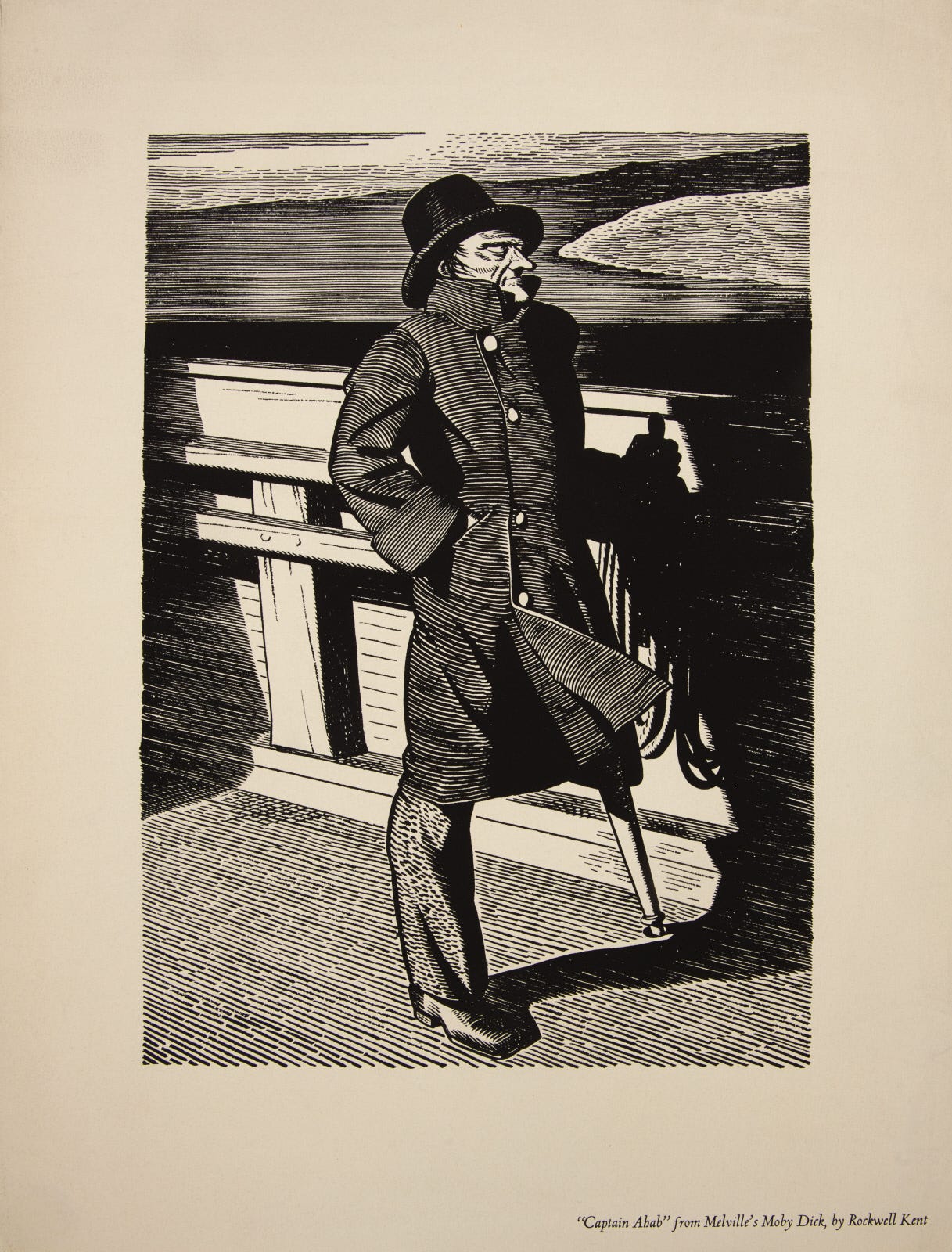
That ending gives visible form to a danger many men know in quieter ways. A man can spend years resisting a father, rival, betrayal, humiliation, injustice or even a wife until the object he opposes begins to organise his life. He calls his fixation strength because he will not yield; his anger, justice because someone truly hurt him; his control, leadership because other people will not give him the recognition he believes he deserves. Yet the grievance chooses his words, governs his relationships and directs his future. What he hates has become his captain.
This essay will help you recognise when masculine strength has become counterfeit—when a mission has become an obsession, when leadership has become control, when steadfastness has become rigidity, and when a household, friendship, institution or life needs someone to stop the ship.
Counterfeit strength often looks impressive. It may be disciplined, courageous, charismatic, purposeful, indifferent to comfort and willing to suffer. It may even command other men and speak the language of honour, responsibility, boundaries, mission and spiritual warfare. Its defect appears not in a lack of power but in the end that governs the power.
Ahab possesses many of the raw materials of masculine greatness: courage, endurance, intelligence, authority, seriousness and unity of purpose. He doesn’t flee danger or scatter himself among trivial pleasures. He can bend thirty men towards one objective. Yet he can’t master the injury around which he has built his identity.
With the help of Nietzsche, we will see how Ahab’s supposed sovereignty remains reactive. Although he appears to create meaning, in fact his enemy creates him. And Thomas Aquinas will help us see why such reactivity corrupts real excellence because strength becomes virtue only when reason orders it towards a true good. We will explore how Melville presents moral disorder as failed navigation, how wounded love hardens into the destructive character and how this relates to modern accounts of narcissism that explain how grandiosity can defend humiliation and require other people to mirror the injured man’s importance.
Melville doesn’t present these ideas as a treatise. Instead, he gives them a wounded body, a commanding voice, a ship, an ocean, a crew, a whale and a rope. Arthur Schopenhauer’s distinction between perceptual and abstract knowledge in The World as Will and Representation helps explain Melville’s method. Philosophy renders experience through concepts; art places truth before us in an individual, perceptible form. Thus Melville gives dramatic form to what Aquinas and Nietzsche enable us to name.
The result is not a warning against masculine power but a warning against power that has ceased to answer to truth.
This is the moral question of Moby-Dick:
When must a man stop the ship—and what in him makes stopping feel worse than destruction?
I. Narcissus Goes to Sea
The first man destroyed by water in Moby-Dick is not Ahab but Narcissus.
Near the beginning of “Loomings,” Ishmael recalls the youth who saw his image in a fountain, could not possess it, reached after it and drowned. Ishmael then extends the myth to every river and ocean. Human beings gaze into the waters searching for an elusive image of life and of themselves. He calls the myth “the key to it all.”
Narcissus is often reduced to a vain man who admired his appearance, but Melville’s use of the myth goes deeper. Narcissus can’t distinguish adequately between image and reality, between desire and knowledge, between what the world reflects and what the world is. He treats an appearance as an object he should be able to grasp, and his attempt to possess the image destroys him.
Ahab repeats the pattern violently: whereas Narcissus tries to embrace the image, Ahab tries to harpoon it.
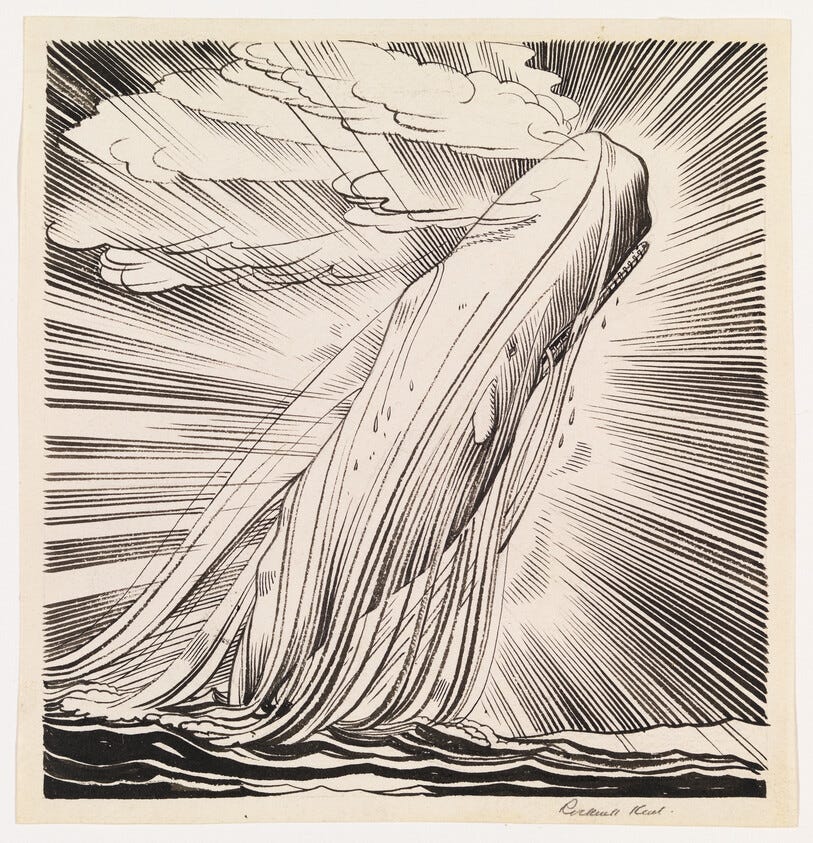
The whale has taken Ahab’s leg, but Ahab can’t allow the event to remain a natural collision between a human body and an animal. Such an interpretation would force him to live with contingency, vulnerability, mortality and a world not centred upon his moral drama. He therefore transforms the whale into the visible mask of an invisible hostility.
In “The Quarter-Deck,” Ahab tells Starbuck that visible objects are pasteboard masks concealing an inscrutable force. The task, he says, is to strike through the mask. The White Whale becomes the wall placed before him by whatever power governs existence.
This interpretation gives Ahab a cosmic enemy, but it also converts reality into self-reference. The animal can no longer possess its own nature or act according to its own instincts. It must mean what Ahab needs it to mean. Ultimately, it must be about Ahab.
Melville makes this habit unmistakable in “The Doubloon.” Different sailors read different meanings in the gold coin nailed to the mast. When Ahab studies it, however, every engraved image becomes a figure of himself: “all are Ahab.” Instead of disclosing an independent world, then coin thus merely reflects the captain’s own identity.
Modern accounts of narcissism are useful here, provided we use them as an analogy rather than a retrospective clinical diagnosis. Pathological narcissism doesn’t consist simply in thinking highly of oneself. Psychological research distinguishes two intertwined dimensions: narcissistic grandiosity and narcissistic vulnerability. Grandiosity may involve superiority, entitlement, self-importance and demands for admiration; vulnerability may involve shame, unstable self-esteem, hypersensitivity to criticism and intense reactions to injury.
Ahab displays both.
His grandiosity appears whenever he treats his private injury as a matter of cosmic importance. He puts the sun on trial, converts a commercial voyage into his personal war and requires the crew to swear themselves into his grievance. He can’t accept a world whose meaning does not turn upon his defiance.
Yet this grandiosity rises around a profound vulnerability. The whale hasn’t merely damaged Ahab’s body but also humiliated his imagined sovereignty. It has revealed that a man of exceptional will can be broken by a creature that neither knows nor recognises his greatness. Ahab can’t bear that asymmetry. He must recast the wound as an intentional insult so that he can answer it with an intentional act.
He experiences injury as humiliation then transforms humiliation into a grand theory of injustice. To him, revenge becomes the restoration of his true stature. And he recruits witnesses to confirm that the struggle is as important as he feels it to be.
Faulkner captured the hardening that follows when he described Ahab’s tragedy as a Golgotha of the heart made immutable as bronze. Ahab’s exterior hardness doesn’t prove that he has overcome vulnerability but merely encased it. He can’t mourn his loss because mourning would require him to accept an irreversible deprivation and build a life no longer organised around vindication, so he chooses instead to monumentalise the wound.
Narcissism also distorts his relations with other people. Ahab needs more than sailors to row boats: he needs witnesses. The crew’s excitement reflects his importance. Their obedience confirms his power. Their oath confirms his interpretation. Their willingness to die assures him that his grievance is not merely private.
He needs them to participate in being Ahab. And that need distinguishes genuine authority from narcissistic control. A real leader can tolerate the independent judgment of those he leads because he governs for a good greater than his emotional stability. But a narcissistic leader experiences another person’s independence as a threat to the world he has constructed. Counsel becomes disloyalty. Hesitation becomes cowardice. Difference becomes insult.
Starbuck sees the danger. Ahab asks, “Who’s over me?” The question announces his refusal of every superior measure. Yet his treatment of those below him reveals the hidden contradiction: he claims absolute independence while demanding absolute participation from others.
The narcissistic man declares himself independent while requiring an entire world of mirrors. He can’t receive contradiction as information because contradiction threatens the self he has constructed. He therefore turns counsel into insult, limits into hostility and correction into betrayal.
So stopping the ship becomes so difficult. Ahab experiences a change of course not as the correction of a decision but as the collapse of Ahab. The voyage has become the external form of his identity, and to abandon the hunt would require him to distinguish himself from his grievance, his authority from his infallibility, and his strength from his refusal to yield.
A man can stop a mistaken action only when he possesses a self deeper than the performance he must surrender. Ahab doesn’t.
II. Why Ahab Looks Like a Hero
No one follows a grievance merely because it is a grievance. Ahab gives his grievance the shape of greatness.
Melville first presents him like a bronze sculpture cast from an unalterable mould. The scar and missing leg don’t diminish his presence. They intensify it. He appears less like a sick man than an image of endurance.
In “America Between Two Myths: Moby-Dick as Epic,” Bainard Cowan connects Ahab with the heroic destroyer, the figure whose visible wounds, courage, pride and capacity for command give rebellion a grandeur that ordinary vice could never possess.
The comparison with Satan in Book I of John Milton’s Paradise Lost is especially revealing. Milton’s Satan carries wounds, intelligence, courage, pride and contemplated revenge. Defeat has not broken his capacity for command. He converts pain into rhetoric and rhetoric into corporate rebellion. And the very qualities that make him admirable at the natural level make his spiritual refusal more terrible.
Ahab likewise possesses authentic natural goods. He can endure pain. He despises comfort. He can make decisions and organise action around them. He faces death without flinching. A shallow moral reading would deny these goods because it fears that acknowledging them might excuse him, but a better reading grants them precisely because their corruption constitutes the tragedy. As Thomas Aquinas explains in Question I of Quaestiones Disputatae de Malo, evil is not a positive substance existing independently of good. It is the privation of a perfection that should exist in a good subject. A blind eye remains an eye, but it lacks the sight proper to an eye. A vicious man retains genuine powers, but those powers lack their proper moral order.
Ahab couldn’t destroy the Pequod in Ahab’s manner if he were merely petty, cowardly, stupid or weak. His evil requires courage to carry it into danger, intelligence to coordinate it, imagination to magnify it, eloquence to communicate it and authority to extend it through other men.
Thus counterfeit strength always borrows its materials from real strength.
That helps explain the quarter-deck scene. Ahab doesn’t announce a bureaucratic change in the ship’s itinerary. He stages an initiation, displays the doubloon, calls the men into common focus, questions them rhythmically, passes the cup among the harpooners and ultimately transforms commercial sailors into participants in a sacred war.
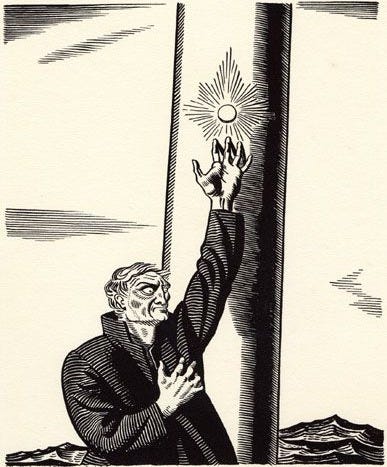
The crew thus feels enlarged because Ahab has lifted them from ordinary labour into myth.
Cowan calls this a charismatic tyranny that can feel like brotherhood. Destructive masculine leadership rarely advertises itself as domination. Instead, it promises unity, danger, loyalty, seriousness, sacrifice and release from a trivial life. Men don’t merely submit to such a leader. They feel more alive around him.
Yet brotherhood and charismatic tyranny differ at their root. Brotherhood joins men in service to a good they can share. Each man remains a participant whose flourishing belongs to the group’s purpose. But charismatic tyranny joins men through participation in the leader’s ruling passion. The followers become emotional organs of one man’s grievance. Ahab doesn’t invite the crew to deliberate about a common good; instead, he intoxicates them with his private end. Starbuck knows the voyage has been stolen from them, but the captain’s intensity makes ordinary judgment look petty. The crew’s excitement returns to Ahab as proof that his obsession possesses objective grandeur.
And a destructive man often creates fellowship by identifying an enemy, giving other men a simple explanation for their frustration and a target upon whom they can concentrate it. The group’s energy therefore feels like courage; its unanimity, truth; its escalating language, moral clarity. Yet the group may possess no positive good beyond the elimination of what its leader hates.
So although Ahab gathers followers, he can’t form friends. Friendship requires another person to remain truly other. A friend may correct, oppose or limit me because he loves a good that neither of us owns. But Ahab can’t sustain that relation. Starbuck becomes useful when he obeys and intolerable when he judges. And Pip awakens tenderness in Ahab, but even tenderness can’t alter the governing end.
Faulkner’s bronze therefore becomes more than an image of endurance: it marks the difference between firmness and rigidity. A firm man can resist pressure because he adheres to a real good, but a rigid man resists reality because he adheres to his previous act of will. So whereas the firm man can stop when the good requires it, the rigid man interprets stopping as humiliation — indeed, a threat to his identity.
That difference is easy to miss because both men may look determined. Both may endure criticism. Both may stand alone. But only one remains free to change course.
We have to ask not only whether a man can drive the ship through opposition but whether anything true can still make him stop it.
III. The Nietzschean Temptation
Ahab refuses to let suffering remain meaningless, and in Beyond Good and Evil, particularly Section 260, Nietzsche presents the noble type as one who determines value rather than passively receiving the judgment of the crowd. In Thus Spoke Zarathustra, especially “On Self-Overcoming,” life appears as self-surpassing power: the creator must break old tables before he can establish new ones. Thus Nietzsche attacks passive resignation, herd conformity, inherited valuation and the weakness that disguises itself as moral superiority.
At first glance, Ahab seems to belong to this world. He refuses a merely zoological account of the whale, refuses to regard the loss of his leg as an accident to be accepted and incorporated and also refuses Starbuck’s conventional moral categories. He creates a meaning large enough to contain his suffering: the whale becomes the mask of whatever hostile force limits human freedom.
And this move has genuine existential power: Ahab won’t let his injury reduce him to an object of pity. Instead, he converts pain into action. He gives himself a mission and makes his shattered body signify not defeat but defiance.
He also possesses extraordinary unity. Most men divide themselves among comfort, reputation, money, distraction, appetite, fear and duty. But Ahab gathers every faculty under one end: his body, imagination, reason, anger, memory, authority and courage all point towards the White Whale.
Nietzsche understands the appeal of such integration. In Thus Spoke Zarathustra, self-command matters more than the domination of others: what cannot obey itself will be commanded. Ahab appears to obey himself absolutely. He eats, sleeps, speaks, navigates and commands according to one purpose.
His famous question—“Who’s over me?”—therefore sounds Nietzschean before it sounds merely insane. It rejects the idea that the self should receive its final measure from an authority above it. Ahab doesn’t wish to discover the good but to legislate the meaning of his own suffering.
And here we can place Nietzsche in illuminating opposition with Aquinas. Like Nietzsche, Aquinas also condemns cowardice, pusillanimity, passivity and the refusal of great responsibility. But the deeper disagreement concerns whether greatness receives its measure from a real order of goods or creates the values by which it justifies itself.
Ahab chooses self-legislation. He treats intensity as evidence. Because he feels his injury cosmically, it must possess cosmic meaning. Because his will is strong, its object must deserve pursuit. Because he can force others into his mission, he imagines that he has demonstrated the mission’s greatness.
This is a constant temptation for capable men. Competence makes self-deception more dangerous because the competent man can produce results. He can confuse the success of his means with the goodness of his end. He can organise people, withstand pain, accumulate resources and overcome resistance. Each achievement seems to ratify the original desire.
Ahab understands the distinction for one lucid instant. He recognises that all his means remain sane while his motive and object have become mad. But that confession doesn’t save him. Tactical reason remains in the service of a corrupted end.
A man may therefore become highly disciplined without becoming virtuous. He may be courageous in defence of pride, sexually restrained in service of ambition, industrious in pursuit of revenge, articulate in rationalising resentment and decisive in imposing disorder.
Nietzsche helps us respect the power, but he also gives us the weapon that turns against it.
IV. Ahab Fails Nietzsche’s Own Test
The most devastating criticism of Ahab is not that he lacks will but that his will belongs to the whale.
In the First Treatise of On the Genealogy of Morality, especially Sections 10 and 11, Nietzsche contrasts active valuation with ressentiment. The active person begins from an affirmation of his own power and creates outward from abundance. The person of ressentiment begins with an injury, an enemy, an obstruction or an impotence he cannot overcome directly. His identity becomes reactive. He needs an opposing figure in order to know who he is.
And Ahab fits the second structure. He doesn’t choose the whale from a surplus of life. The whale has already chosen him by wounding him. The injury supplies his metaphysics, and his enemy supplies his identity. Revenge is his mission. Every apparent act of self-creation remains an answer to something Moby Dick has done.
Indeed, what would remain of Ahab’s heroic self-conception if the whale ceased to matter? Could he return home? Receive the love of his wife? Be a good father to his child? Endure being a wounded man rather than a cosmic antagonist?
He can’t imagine that life because Moby Dick has become necessary to the existence of Ahab as Ahab. Ahab lives for the great, unquestionable deed, but the deed springs from anger, hurt and resentment rather than positive desire. Ahab possesses the form of heroic action but the motive of ressentiment. Instead of overcoming the wound, he enlarges it until it becomes a theory of existence.
Hence his pursuit can’t end in ordinary success. Even if he killed the whale, no dead animal could answer the metaphysical demand he has placed upon it. The injury would remain. Mortality would remain. The opacity of providence would remain. Ahab would have destroyed the object without resolving the need that made it indispensable. His action therefore circles rather than advances. He sails across oceans, but psychologically he never leaves the moment of mutilation. The grandiose self can’t integrate the wound because the wound contradicts its claim to exceptional sovereignty, so it therefore externalises the contradiction. The hated other becomes the bearer of weakness, malice, humiliation and limitation. Destroying the other promises to restore the self’s imagined wholeness.
Yet the projection gives the other enormous power. The enemy now regulates attention, mood, action, identity and hope. A man may dominate everyone around him while remaining inwardly governed by the person he resents.
Men have many white whales in ordinary life. A man claims he has moved on from a former lover while arranging his achievements for her imagined gaze. A husband says he merely wants respect, but every conversation becomes a test of whether his wife validates his standing. A father spends years defining himself against his own father and calls the resulting reactivity independence.
Ahab asks who stands over him. And of course the whale does.
In his 1931 essay “The Destructive Character,” Walter Benjamin describes a character who clears away, removes obstacles and sees paths where others see permanent structures. Destruction creates an immediate experience of potency because it simplifies the world into what can be broken or removed.
Ahab destroys superbly, but what does he create?
No home, no friendship, no law, no inheritance, no reconciliation, no stable brotherhood and no future. He can’t repair the relations he damages or generate a good that survives the moment of assertion. He turns a productive voyage into a vehicle of annihilation. He converts authority, craftsmanship, courage and communal labour into fuel for an assault.
His is the way of machismo, not masculinity. Destruction produces an immediate sensation of potency. A man can silence a room, frighten a child, cut off a woman, humiliate a rival, resign dramatically, break an agreement, abandon a community or force a confrontation. The clean rupture feels powerful because the slower work of creation demands patience, limitation, cooperation, correction and fidelity.
Unlike destruction, creation exposes a man to realities he cannot dominate. A household includes independent persons. A child develops a will. A marriage requires forgiveness. An institution needs procedures that limit its founder. Friendship requires reciprocity. Craftsmanship submits imagination to material. Creation tests whether a man can serve a form that is not identical with his mood.
Ahab’s power is ultimately sterile. Instead of displaying strength stemming from abundance, he is merely reacting to a wound.
V. Aquinas and the Moral Form of Strength
Power becomes virtue only when it takes the right shape.
Aquinas’s moral thought begins from ends. In Questions 1–5 of the First Part of the Second Part of the Summa Theologiae, he argues that deliberate action seeks an apprehended good. A person may choose something that merely appears good, but the will never moves except under some aspect of goodness.
Ahab doesn’t desire evil simply because it is evil. He desires vindication, justice, freedom, intelligibility and victory. These are recognisable goods. His corruption lies in how he understands them, ranks them and what he permits himself to sacrifice for them.
The distinction matters because we rarely describe our worst conduct honestly. Control presents itself as order. Revenge presents itself as justice. Withdrawal presents itself as a boundary. Pride presents itself as dignity. Emotional numbness presents itself as composure. Domination presents itself as leadership. Obsession presents itself as mission.
Aquinas thus asks not only what name the man gives his desire but what object and end actually specify the act.
A false last end
Ahab has made the destruction of the whale function as a false last end.
In the opening questions of the First Part of the Second Part of the Summa Theologiae, Aquinas explains that deliberate acts take their order from an ultimate end. Other goods attract the will insofar as the person connects them, rightly or wrongly, with fulfilment. Every deliberate act seeks some good, and finite goods become dangerous when a person treats them as though they could provide final happiness.
Ahab connects everything with the whale:
His bodily integrity.
His honour.
His idea of justice.
His freedom.
His metaphysical knowledge.
His authority.
The meaning of his suffering.
The whale thus becomes the point through which all roads to fulfilment appear to pass, and Ahab consequently orders every subordinate power towards it. His reason devises methods. His imagination attributes universal malice. His anger supplies energy. His courage accepts danger. His eloquence recruits the crew. His office supplies material force.
This is why simple insight does not free him. He knows at moments that the object is mad. But knowledge at one level cannot save a will that has organised the whole personality around another judgment of value.
In On Evil, Aquinas explains that passion and habit can fetter reason in concrete choices even when a person retains general moral knowledge. The person doesn’t always sin because he lacks the principle. He may fail to judge the particular truthfully because his attachments have altered what appears desirable.
Thus Ahab knows abstractly that the pursuit will cost innocent lives; concretely, however, every warning appears smaller than the whale because his disordered love has changed his perception.
Evil feeds upon good
But Aquinas’s account of evil as privation prevents us from calling Ahab simply weak.
Ahab’s courage remains courage as a natural power; what it lacks is governance by justice and prudence. His intelligence remains sharp; what it lacks is a true governing end. His authority remains effective; what it lacks is orientation towards the common good.
This helps us to understand that natural strength and moral strength aren’t identical. Natural strength concerns capacity: what can this man endure, organise, penetrate or overcome? Moral strength concerns order: which good governs the capacity, by what means, under whose authority and at whose cost?
Ahab is naturally strong yet morally disordered. His natural strength magnifies rather than excuses the disorder because it enables him to extend a private vice through an entire community.
Magnanimity or pride?
Ahab wants greatness, and Aquinas doesn’t condemn that desire. Indeed, in Question VIII of On Evil, Aquinas argues that human beings naturally desire excellence. When reason informed by God measures that desire, it becomes loftiness of spirit. When a man falls below the proper measure, he becomes pusillanimous. When he exceeds it, he falls into pride—an appetite for perverse eminence.
The corresponding virtue in Question 129 of the Second Part of the Second Part of the Summa Theologiae is magnanimity. Magnanimity disposes a person to undertake great and honourable actions proportionate to his gifts. It is not swagger, self-advertisement or fantasy. It requires accurate self-knowledge and an object worthy of great effort.
Ahab possesses the material appearance of magnanimity. He undertakes something vast. He accepts suffering. He refuses petty comfort. He aims beyond ordinary commerce.
But his object isn’t honourable. His greatness doesn’t answer to a vocation, office or common good. Instead, it asserts exemption from measure itself.
“Who’s over me?” reveals the core of his pride. In Question 162 of the Summa Theologiae, Aquinas presents pride as the inordinate pursuit of excellence and as resistance to proper subjection. In Question VIII of On Evil, he adds that pride loves one’s good as though it didn’t come from another.
A magnanimous man says:
I have received powers for great work, and I must not bury them.
The proud man says:
My powers entitle me to decide what counts as great.
The first recognises both gift and task. The second treats possession of power as its own jurisdiction.
Ahab’s ability to command doesn’t give him the right to make his crew instruments of revenge. His willingness to die doesn’t give him the right to choose death for others. His suffering doesn’t confer authority over nature or providence. His greatness is real as capacity but false as title.
Fortitude or hardness?
Ahab also looks courageous because he fears neither whale nor death. Yet Aquinas’s account of fortitude in Questions 123–140 of the Second Part of the Second Part of the Summa Theologiae doesn’t identify courage with maximal daring. Fortitude governs fear and confidence according to reason. Its primary act often consists not in attacking but in enduring the right danger for the right good.
A man may rush into danger because pride makes retreat intolerable, refuse to reconsider because shame makes correction unbearable and call himself steadfast because he cannot admit that he has chosen badly.
Fortitude asks what the danger serves.
Ahab’s daring serves an unjust end. He risks lives that don’t belong to him and disregards the duties of his office. Treating prudent opposition as cowardice, he can’t distinguish fidelity from fixation.
“The Symphony” exposes this defect. Near the end of the voyage, Ahab looks across the peaceful sea, remembers the forty years he has sacrificed to whaling, thinks of the young wife he effectively widowed and the child he scarcely knows, and recognises the folly of his life. For a moment, ordinary goods regain their proper size. Home, marriage, fatherhood, rest and tenderness become tangible:
“Oh, Starbuck! it is a mild, mild wind, and a mild looking sky. On such a day- very much such a sweetness as this- I struck my first whale- a boy-harpooneer of eighteen! Forty- forty- forty years ago!- ago! Forty years of continual whaling! forty years of privation, and peril, and storm-time! forty years on the pitiless sea! for forty years has Ahab forsaken the peaceful land, for forty years to make war on the horrors of the deep! Aye and yes, Starbuck, out of those forty years I have not spent three ashore. When I think of this life I have led; the desolation of solitude it has been; the masoned, walled-town of a Captain’s exclusiveness, which admits but small entrance to any sympathy from the green country without- oh, weariness! heaviness! Guinea-coast slavery of solitary command!- when I think of all this; only half-suspected, not so keenly known to me before- and how for forty years I have fed upon dry salted fare- fit emblem of the dry nourishment of my soul!- when the poorest landsman has had fresh fruit to his daily hand, and broken the world’s fresh bread to my mouldy crusts- away, whole oceans away, from that young girl-wife I wedded past fifty, and sailed for Cape Horn the next day, leaving but one dent in my marriage pillow- wife? wife?- rather a widow with her husband alive? Aye, I widowed that poor girl when I married her, Starbuck; and then, the madness, the frenzy, the boiling blood and the smoking brow, with which, for a thousand lowerings old Ahab has furiously, foamingly chased his prey- more a demon than a man!- aye, aye! what a forty years’ fool- fool- old fool, has old Ahab been! Why this strife of the chase? why weary, and palsy the arm at the oar, and the iron, and the lance? how the richer or better is Ahab now? Behold. Oh, Starbuck! is it not hard, that with this weary load I bear, one poor leg should have been snatched from under me? Here, brush this old hair aside; it blinds me, that I seem to weep. Locks so grey did never grow but from out some ashes! But do I look very old, so very, very old, Starbuck? I feel deadly faint, bowed, and humped, as though I were Adam, staggering beneath the piled centuries since Paradise. God! God! God!- crack my heart!- stave my brain!- mockery! mockery! bitter, biting mockery of grey hairs, have I lived enough joy to wear ye; and seem and feel thus intolerably old? Close! stand close to me, Starbuck; let me look into a human eye; it is better than to gaze into sea or sky; better than to gaze upon God. By the green land; by the bright hearthstone! this is the magic glass, man; I see my wife and my child in thine eye. No, no; stay on board, on board!- lower not when I do; when branded Ahab gives chase to Moby Dick. That hazard shall not be thine. No, no! not with the far away home I see in that eye!”
But he can’t stop the ship, so he turns back towards the whale. And that return is not fortitude but pertinacity: the refusal to abandon a chosen course after reason has exposed its disorder. This speech is critical because it’s a moment of true moral insight without conversion. Ahab sees, with unusual clarity, what his life has become. He stands closer to Macbeth than to Oedipus. Oedipus is destroyed chiefly by what he does not know; his tragedy is one of discovery. Macbeth and Ahab are darker figures, because both see, at least intermittently, what their ruling passion is doing to them, and yet they continue. Macbeth knows he yields to ambition. Ahab knows he has become dry, solitary, and less than fully human. Their tragedy lies not simply in suffering or blindness, but in disordered willing.
Melville shows Ahab on the edge of repentance, almost recognizing the hierarchy of goods by which a human life must be governed, and yet failing to live by the truth he sees.
“Forty years of continual whaling” shows Ahab measures his life by repetition. Repeated acts form habits, and habits shape character, then character shapes destiny. A life is not just a list of events but the sediment of chosen acts. Ahab has become the kind of man his long practice has made him.
“Forty years of privation, and peril, and storm-time” is important because, for Aquinas, evil is not a positive substance but a privation of due good. Ahab’s tragedy is not that he has acquired some grand dark power but that he has been progressively emptied of goods proper to man: peace, domestic life, friendship, rest, proportion, and right order.
“The desolation of solitude” he experiences as a result is thus not holy solitude but isolation. Ahab has cut himself off from the common goods of human life. As a social animal, man is not self-sufficient. Human flourishing belongs within ordered relations: family, friendship, and society. Ahab’s solitude is mutilation, not grandeur.
And “the masoned, walled-town of a Captain’s exclusiveness” shows how he’s turned office into identity. Authority has become enclosure. A role that should serve the common good has been appropriated into a private fortress. Insteada of simply enduring loneliness, Ahab has embraced and institutionalised it.
The “guinea-coast slavery of solitary command” shows how sin promises mastery, but disordered passion enslaves. What looked like strength has become bondage. Ahab ruled the ship, but he didn’t rule himself.
“I have fed upon dry salted fare — fit emblem of the dry nourishment of my soul” shows how Ahab has pursued apparent goods that don’t perfect him. Evil can’t nourish because it is privation. It leaves a man lean, brittle, and joyless. Ahab sees that outward diet mirrors inward diet. He has lived on preserved, hard, nonliving substitutes, and so has his soul, leaving him with a kind of spiritual scurvy.
By contrast, “the poorest landsman has had fresh fruit … and broken the world’s fresh bread,” shows how Ahab realises that the common man may possess more real good than the heroic pursuer of vast ambitions. Beatitude is not found in restless magnitude, power, or fame. “Fresh fruit” and “fresh bread” suggest immediacy, creaturely abundance, ordinary happiness, and shared life Ahab lacks.
“Away, whole oceans away, from that young girl-wife I wedded” is when the speech becomes explicitly vocational. Ahab’s ruin isn’t abstract. He has failed in a concrete state of life. Duties arise from one’s condition and relations, and marriage imposes real obligations of companionship, provision, and shared life. Ahab sees that his vocation as husband was displaced by his vocation as captain.
Thus “leaving but one dent in my marriage pillow” is an image of almost comic smallness, but that is why it wounds. Marriage has been reduced to a physical trace. The domestic sign remains; the substance is missing. This is a sign of privation again: form without fullness, title without lived reality.
When Ahab asks “wife? wife?—rather a widow with her husband alive?” it’s one of his clearest acts of self-judgment. He sees that he gave the name of husband while denying the good that name requires. He recognises a disorder against justice and charity within marriage: he has withheld the common life proper to the bond. She is not literally widowed, but morally and emotionally he has made her one.
Thus “I widowed that poor girl when I married her” exposes the whole tragedy of misordered vocation. Marriage should initiate shared life; in his case it initiated abandonment. Ahab joins beginning and deprivation in one act. What should have been a good became, through his choices, the occasion of a lack — not a new substance, but the corruption of a due good.
“The madness, the frenzy, the boiling blood and the smoking brow” show how Ahab names passion as passion. For Aquinas, passions are not evil in themselves, but when they overrun reason they impede judgment and freedom. Ahab describes the bodily and psychic sign of a man no longer well governed from above.
He knows he is “more a demon than a man,” seeing his dehumanisation. To become less rationally ordered is to become less fully human. His obsession has darkened what is proper to man as a rational creature ordered to the good. As Nietzsche warned, “He who fights with monsters might take care lest he thereby become a monster.”
“What a forty years’ fool … has old Ahab been” is thus not mere self-pity but a verdict on false wisdom. Ahab now sees that his practical reasoning has been governed by a false end. Folly is not lack of cleverness but misjudgment about the highest good. He has lived intelligently toward the wrong object.
“Why this strife of the chase?” is the question of final causality: what is this for? An act, and still more a life, must be judged by its object and its end. Ahab is finally asking whether his governing pursuit has truly perfected him. His own answer is no: “how the richer or better is Ahab now?”
This hits with the force of a catechetical question. Has the pursuit made him better? Has it enriched his being? Genuine good perfects the subject. If a lifetime of striving leaves a man thinner in soul, then the object sought was not his true good, however splendid it appeared.
Yet “one poor leg should have been snatched from under me” shows Ahab still speaks partly from wounded self-regard. He laments not only loss but insult. His grievance feeds the moral logic of vengeance. Aquinas treats anger as seeking an apparent good under the aspect of retribution, and Ahab’s injury has become a principle of identity.
“Locks so grey did never grow but from out some ashes” suggests a life already half-burned. Ash is what remains when fire has consumed its matter, reminding us of privation again — not fullness ripened into wisdom, but fuel spent.
“Have I lived enough joy to wear ye” shows he feels old without having possessed the good that should crown age. Man’s last end is not in wealth, honour, power, or external success. Ahab has accumulated years, exploits, and command, but not beatitude.
Indeed, “as though I were Adam, staggering beneath the piled centuries since Paradise” shows how Ahab feels not only personal exhaustion but fallen humanity itself: exile, burden, distance from original peace. His own history is a concentrated form of man’s disordered condition after the fall.
“Let me look into a human eye” is a decisive turn because, for a moment, Ahab seeks not conquest or abstraction but personal presence. He wants relation. It’s a momentary recovery of real human goods: communion, sympathy, and the concreteness of another person. He is pulled, briefly, back toward the good proportioned to man.
Yet “it is better than to gaze into sea or sky; better than to gaze upon God” is both true and disordered. It is true in that Ahab can receive some healing through a mediated, creaturely good — through a human face rather than through vast impersonal immensities. But it is disordered because he ranks the creature above the Creator. Created goods are real goods only when ordered under the highest good, who is God. Ahab half-recovers order but then immediately inverts it.
“This is the magic glass, man; I see my wife and my child in thine eye” means the human eye becomes a mirror of home. Briefly, Ahab’s imagination is fixed not on Moby Dick but on wife and child. He sees that the human person reflects the world of domestic and filial goods he has forsaken. Through the visible human presence, absent loves become present to him again.
“No, no; stay on board … That hazard shall not be thine” represents a real moral movement occurs here because Ahab wishes to spare Starbuck. Briefly, another man’s good enters his practical judgment. Thus the tyrant isn’t pure negation: some rightly ordered movement survives in him. Evil never wholly destroys the good in its subject. Like Milton’s Satan, Ahab is “majestic though in ruin.”
But ultimately Ahab sees truly yet doesn’t convert. His speech is like an examination of conscience. He names privation, false ends, failed vocation, wounded humanity, and the superiority of human communion to his obsessive chase. Yet he doesn’t actually reorder his life. The passage is Ahab’s near-recognition of the true hierarchy of goods: God above all, then rightly ordered human goods, then subordinate pursuits. That is the grandeur and horror of the scene. Its grandeur lies in that near-recognition; its horror lies in the fact that he goes on. He glimpses order, mourns its loss, and still cannot live by it. Knowledge alone does not heal; the will must turn, the end must change, and repeated action must follow.
The firm man can repent, but the rigid man must remain consistent with his performance. This is Faulkner’s bronze: virtue makes a man stable in the good, but vice can make him immovable in a decision. The two may look alike under pressure, yet their difference appears when truth requires a change of course.
Anger or justice?
Ahab’s most convincing self-deception concerns anger: he calls his desire not spite but justice.
Aquinas gives anger a subtle treatment in Question XII of On Evil. Anger seeks to inflict an evil under the appearance of just retribution. For that reason, anger lies closer to virtue than hatred does: hatred may seek another’s evil as evil, whereas anger still claims some relation to justice. But this proximity makes anger especially capable of deception.
Aquinas describes the angry person magnifying the injury in his imagination, dwelling upon disrespect, devising methods of revenge and allowing the apparent justice of retaliation to inflate his ego. Anger then generates indignation, insults, quarrels and even blasphemy against God for permitting the injury.
This reads like a psychological and spiritual anatomy of Ahab. He begins with a real harm — the loss of his leg. He then enlarges the injury into an intentional injustice, attributing moral malice to a brute animal. Next, he identifies the animal with the hostile structure of existence and imagines himself authorised to punish that structure. Finally, he condemns every human and divine limit that refuses to ratify his jurisdiction.
Anger hears one true proposition—I have suffered—and silences all the questions that should follow:
Who or what caused the suffering?
Did the agent act culpably?
What response is proportionate?
What authority do I possess?
What good would retaliation restore?
What costs may I impose upon innocent people?
Ahab answers none of them because his anger no longer serves judgement.
In On Evil, Aquinas distinguishes virtuous anger from anger that opposes gentleness, charity and true justice. Anger can lend force to a judgment already made by reason, but it becomes vicious when it assumes command.
This is meekness properly understood. Meekness doesn’t abolish anger or make a man harmless. Instead, it keeps anger in its office. A meek man can correct, punish, protect, confront and fight. His emotional force follows justice rather than defining it.
Despite the appearance of strength that its intensity gives it, Ahab’s anger is weak in this decisive respect: he can’t make it obey.
Prudence or tactical intelligence?
Ahab is also brilliantly intelligent, but that doesn’t make him prudent.
In Questions 47–56 of the Second Part of the Second Part of the Summa Theologiae, Aquinas defines prudence as perfected practical reason. Prudence doesn’t merely identify efficient means towards whichever end desire happens to choose. It deliberates, judges and commands within the order of the true good.
Genuine prudence thus differs from the counterfeit cleverness that finds effective means towards a corrupt end. Personal prudence must also expand into domestic and political prudence, which direct households and communities towards their proper common goods.
Ahab has strategy without prudence. He can read charts, manage men, foresee movements and exploit motives, yet all this competence serves an end that practical reason should reject.
The distinction matters wherever men hold authority. A man may become highly skilled at getting his way. He may anticipate objections, choose effective pressure points, control the timing of conversations, frame alternatives, withhold affection, reward compliance and produce the response he wants. But none of that proves prudence. It may merely be efficient manipulation.
Prudence asks whether the action respects the good of the persons involved, and Ahab doesn’t.
Authority or possession?
A captain’s office exists for the good of the ship, its mission and its crew. Ahab reverses that relation because the ship exists for his interior drama.
The Pequod’s owners have commissioned a whaling voyage, and the sailors have contracted for that purpose. Each man carries his own life, obligations, hopes and relationships. Ahab’s authority gives him power to coordinate their work for the common end, but it doesn’t make their lives extensions of his will.
Aquinas’s account of justice in Questions 57–122 of the Second Part of the Second Part of the Summa Theologiae insists that another person possesses a good and a due that don’t reduce to my emotional purposes. Justice recognises the other as someone to whom I owe something.
Similarly, regarding domestic and political rule, those with authority must possess the prudence to govern themselves and must remain devoted to the welfare of those they rule. A husband’s authority, for example, is for the benefit of his wife and children, not for himself.
Ahab, however, can’t sustain that recognition. Instead, he treats Starbuck’s conscience, the crew’s safety, the owners’ property and the families awaiting the sailors as merely lesser realities inside Ahab’s universe.
Masculine leadership becomes counterfeit whenever a man regards sacrifice by others as proof of his own seriousness.
Humility or self-contempt?
Nietzsche’s suspicion of Christian humility has force because humility is often counterfeited. Fear calls itself peace. Passivity calls itself surrender. Mediocrity calls itself modesty. A man refuses difficult responsibility and congratulates himself for lacking ambition.
But Aquinas doesn’t defend such weakness. In Question 161 of the Second Part of the Second Part of the Summa Theologiae, Aquinas argues that humility and magnanimity cooperate. Magnanimity urges a man towards great things according to reason. Humility restrains him from seeking greatness contrary to reason. Both virtues submit desire to truth.
Humility recognises limitations without denying gifts, rank, office or legitimate authority. It therefore doesn’t require a capable man to pretend he lacks capacity. It requires him to recognise the capacity accurately: its source, limits, office and end.
A humble captain may know that he is the best navigator aboard. He may issue commands without apology and refuse foolish counsel. But he also knows that office doesn’t make him omniscient, suffering doesn’t make him infallible, and authority doesn’t erase the rights of those beneath him.
Humility doesn’t make a man smaller than he is, but it also prevents him from imagining himself larger than reality.
Ahab rejects precisely this truth. He would rather fight the structure of existence itself than receive a measure he did not create.
VI. Stop the Ship: The Man Who Throws Away the Compass
The most dangerous captain isn’t the man who merely loses his bearings but the man who destroys every instrument capable of showing him that he is lost.

Yvor Winters, in “Herman Melville and the Problems of Moral Navigation,” collected in In Defense of Reason, argues that Moby-Dick builds its symbolism around the relation between land and sea. Land represents what human beings have learned, formulated and established as principle. The sea represents the half-known world of unstable perception, instinct, danger, passion and terror.
Winters does not, however, conclude that a good man should remain on shore. That would turn morality into timidity. A person who refuses the sea refuses action, responsibility, risk, discovery and the difficult particulars of life. Man must venture into uncertainty without surrendering his relation to the principles by which he judges it. Winters describes this union of principle and perception as the problem of judgment.
The coward refuses the sea, the reckless man throws away the compass, and the courageous man sails, remaining capable of stopping the ship.
Marriage, fatherhood, command, grief, conflict, illness, erotic love and another person’s freedom all belong to the sea. No rule can eliminate their uncertainty. Yet intensity, sincerity and instinct can’t replace moral orientation. Prudence applies enduring truth to moving circumstances.
Winters finds a positive image in Bulkington, who has scarcely returned from one dangerous voyage before setting out upon another. Bulkington isn’t a timid landsman: he stands at the helm. Yet his daring operates within the laws of navigation and in continuing relation to the land from which he must take his bearings. Winters reads him as an emblem of perception disciplined by principle.
Ahab moves in the opposite direction. As the voyage approaches its end, his means of correction disappear. He destroys the quadrant that tells him his position. The storm reverses the compass needle. The log-line snaps. The life-buoy sinks.
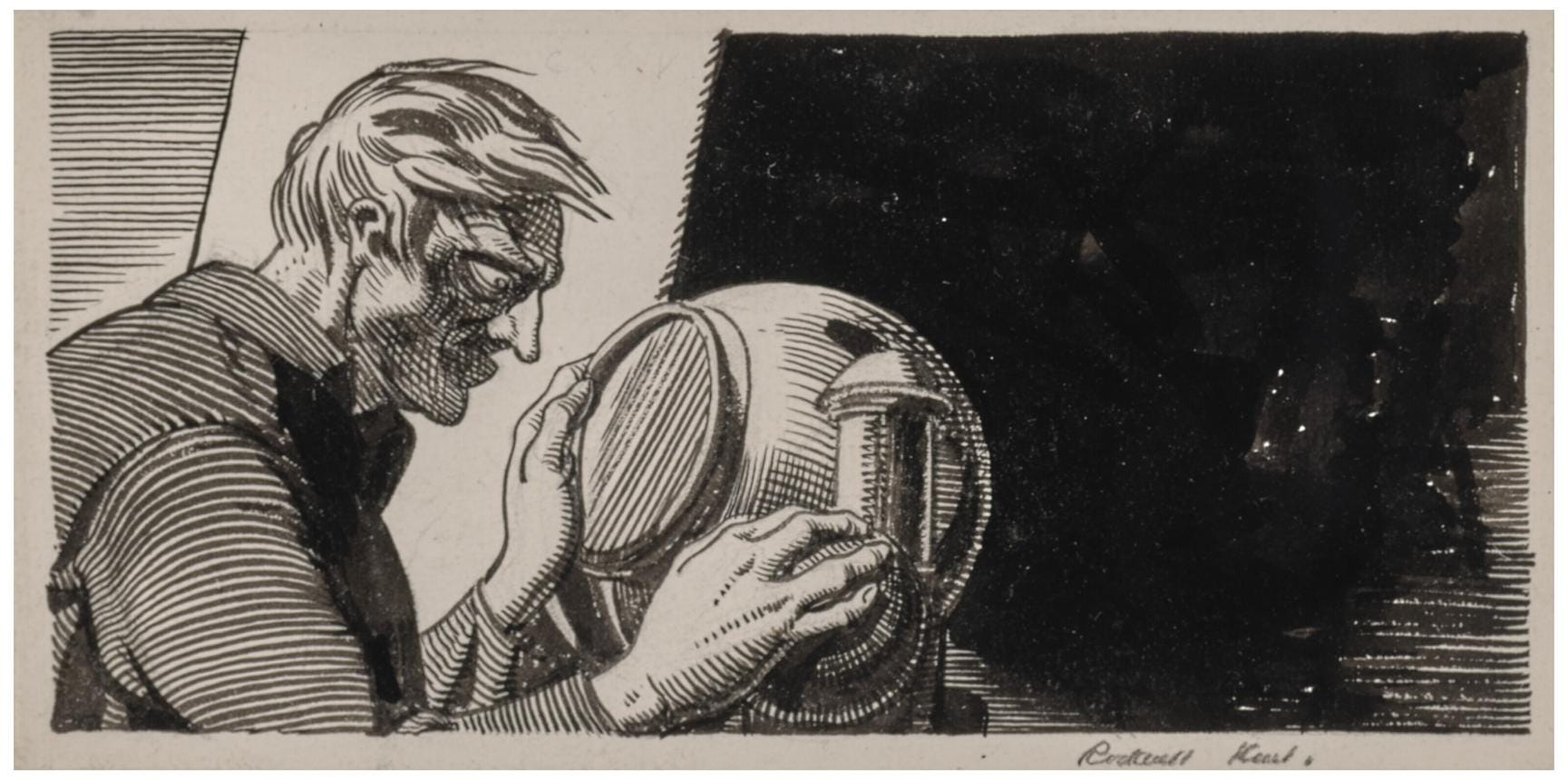
He rejects Starbuck’s counsel and converts each warning into evidence that destiny has chosen him.
The sequence matters because Ahab doesn’t simply make one disastrous decision. He progressively removes the conditions under which a decision can be reconsidered. He can’t tolerate instruments that tell him where he actually stands. A compass receives information from a reality outside the self. A mirror returns an image of the self. Ahab gradually replaces compass with mirror:
Resistance proves the enemy’s power.
Warning proves the greatness of the danger.
Suffering proves the nobility of perseverance.
Dissent proves the loneliness of genius.
Approaching disaster proves the cosmic scale of the contest.
Nothing can falsify his interpretation. Every fact confirms it. His apparent conviction has become a sealed system.
Thus intelligent men lose moral direction without losing intelligence. They continue to interpret facts, but they construct an interpretation that absorbs every contradiction.
A wife’s disagreement becomes disrespect. Her silence becomes contempt; her protest becomes rebellion; her compliance becomes proof that force was necessary. A rejected man interprets every ambiguous gesture as a message intended for him. A leader regards criticism as evidence that he threatens corrupt powers. The story protects itself by converting correction into confirmation.
A compass works only when the navigator permits something outside his will to correct him. Yet Ahab mistakes freedom from correction for freedom of action.
We can therefore interpret ‘stop the ship’ on several levels:
Starbuck must stop the ship. He possesses moral knowledge but lacks the force to convert judgment into effective action.
The crew must stop the ship. They have allowed the emotional intoxication of the quarter-deck to replace personal responsibility.
Ahab must stop the ship. Yet stopping would require him to renounce the identity his grievance sustains.
The reader, too, must learn when to stop the ship. A course becomes most dangerous when accumulated sacrifice, public commitment, pride and resentment make reversal feel impossible. A man often says, “I have gone too far to turn back.” But in moral life, that sentence usually means he has gone too far to continue.
Winters’ reading goes too far, however, in identifying Moby Dick firmly with the spirit of evil. Aquinas’s account in Question I of On Evil resists treating evil as a positive substance embodied in a creature. The whale can represent the apparent presence of evil within Ahab’s imagination without simply being evil itself. It remains a mere animal — limit, opacity, danger, beauty, death, nature — but perhaps an instrument of providence.
Ahab mistakenly collapses this mystery into one enemy he believes he can kill. The man who cannot tolerate mystery manufactures an antagonist. The man who cannot tolerate correction destroys the compass. And the man who can’t repent commands the ship to sail on. Ahab doesn’t refuse to stop merely because he has made an intellectual error. He refuses because the course has become sacred to him. Pain, sacrifice, public commitment and identity have fused. To reverse direction would feel like annihilation and declaring his suffering meaningless.
He can’t stop the ship without confronting his counterfeit Golgotha.
VII. The Counterfeit Golgotha
Suffering doesn’t automatically ennoble a man. Instead, it reveals what he worships.
Faulkner’s description of Ahab as a Golgotha of the heart invites comparison with another wounded man raised above the earth.
Christ’s Golgotha and Ahab’s voyage both involve suffering, public exposure, apparent defeat, blood, will and death. Yet they move in opposite directions.
Christ receives suffering within obedience and gives himself for others.
Ahab interprets suffering as a title to sacrifice others for himself.
Christ’s wounds open outward in charity.
Ahab’s wound closes inward in accusation.Christ forgives his enemies.
Ahab needs an enemy.Christ’s death generates a community.
Ahab’s purpose consumes one.Christ’s authority reaches its fullest expression in self-gift.
Ahab’s authority reaches its fullest expression in commandeering the lives beneath him.
Ahab’s Golgotha is counterfeit not because his suffering is unreal but because he makes suffering self-authenticating. Pain becomes his consecration. The more the voyage costs, the more sacred the mission appears. Every sacrifice seals him more deeply into a course that would otherwise have to be reconsidered.
This mechanism appears often in destructive lives. A man says he can’t turn back because he has already sacrificed too much: the years, money, reputation, conflict and emotional investment become arguments for continuing. He mistakes accumulated cost for moral confirmation.
True sacrifice receives its value from the good for which it is offered. An evil end doesn’t become holy simply because a man suffers greatly to achieve it.
Father Mapple’s sermon on Jonah establishes the true alternative early in Moby-Dick. Jonah flees a command, encounters the storm, descends, recognises his disorder, submits, survives and returns to his vocation. Ahab also descends into suffering, but refuses the movement of repentance. Jonah allows humiliation to break his false course; Ahab converts humiliation into the reason he must never turn.
Kierkegaard names this refusal in The Sickness Unto Death: defiant despair. The despairing self wills to be itself on its own terms, refusing to rest in the power that established it. It experiences dependence not as the condition of creaturely freedom but as an intolerable insult.
Ahab wants to be the source of himself. His missing leg exposes dependence upon body, nature, craftsmen, crew, wood, ship and providence, so his response isn’t to integrate those dependencies but to avenge himself upon the world that revealed them.
So while Nietzsche shows that Ahab remains reactive, and Aquinas shows that his will has rejected proper measure, Kierkegaard shows why submission feels to him like extinction. Ahab would rather die as the creator of a fantasy than live as a creature in reality.
The moral life depends upon the right ordering of love. Ahab loves vindication above justice, his heroic self-image above his crew, fantasy above reality, and revenge above home. His ruling love gathers every subordinate power into its service, and René Girard’s account of mimetic desire and scapegoating in Violence and the Sacred is illuminates how Ahab also teaches the crew what to desire and whom to hate. The whale becomes the one object whose destruction promises unity, release and restored order. Private grievance thus acquires collective force through imitation.
To Ahab, forgiveness is weakness. But as Max Scheler explained, responding to Nietzsche in Ressentiment, mercy and forgiveness may express superior power because they break reactive dependence upon the offender. Forgiveness means refusing to let the injury dictate the final form of one’s will, but Ahab can’t forgive because he can’t imagine an identity that doesn’t require the wound.
VIII. Ishmael vs. Ahab
Ishmael begins in danger. He goes to sea when depression, alienation and destructive impulses gather around him. He too is drawn towards the watery mirror, seeking meaning in the whale.
But Ishmael’s way of knowing differs from Ahab’s. He can entertain several interpretations without forcing them into one total explanation. He moves among theology, cetology, comedy, history, folklore, personal observation and speculation. His meanings proliferate because reality exceeds him. He is receptive to it.
Most importantly, Ishmael can form friendship with Queequeg. He first encounters Queequeg as frightening otherness: foreign body, foreign religion, foreign customs, strange markings and a harpoon in bed. Yet he doesn’t reduce the stranger to a symbol in Ishmael’s private drama. He learns, laughs, revises judgement, shares a room and enters a covenant of friendship.
Whereas Ahab sees otherness and demands submission or destruction, Ishmael sees otherness and becomes capable of relation.
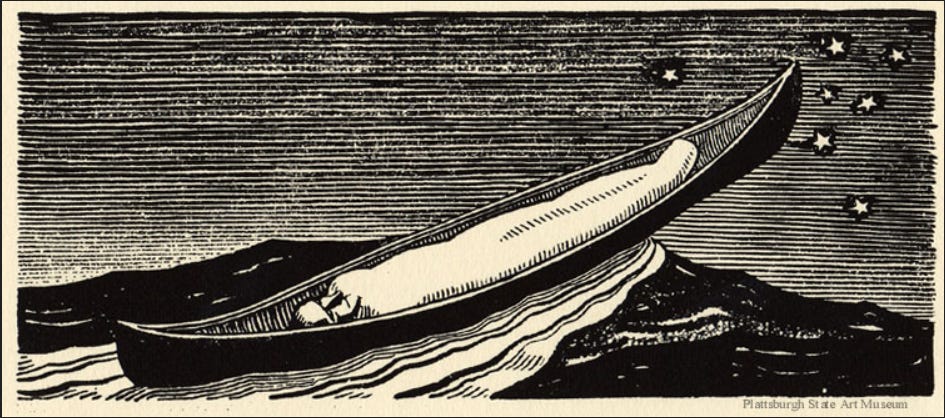
That difference determines the ending. Ahab dies attached to the enemy around whom he has built his identity, but Ishmael survives on Queequeg’s coffin, transformed into a life-buoy, until the Rachel—itself searching for lost children—finds him as another orphan. Thus Ahab’s bond to the other becomes death because he has made the other an object of hatred, but Ishmael’s bond to the other becomes life because friendship has given him something he could never have manufactured alone.
Ahab has a crew but no communion. By contrast, Ishmael loses everyone but survives through friendship. He embodies virtues Ahab lacks: the ability to laugh at himself, the willingness to revise first impressions, hospitality towards mystery, recognition of another person’s independent value, and freedom from the need to make one theory explain everything.
Melville also uses the other characters to highlight Ahab’s flaws. Bulkington faces danger while remaining a helmsman. Jonah accepts correction and returns to his vocation. Starbuck warns that correct principles don’t suffice if a man can’t translate judgment into courageous action.
So the alternative to Ahab isn’t the man who never leaves the harbour but the man who can sail without making landlessness his god.
IX. Who Can Stop the Ship?
The novel warns men against allow an injury to choose their destination.
To return to the scene in Warrior, Paddy cries for Ahab’s ship to stop while alcohol, grief, guilt and his son’s rejection carry him down a course he knows will destroy him. Yet the scene doesn’t permit a simple division between guilty father and innocent son. Paddy’s failures helped form Tommy’s rage; Tommy’s rejection now wounds Paddy at the point of his shame. Each man becomes both injured and injuring, driven and driving.
Still, neither man can surrender responsibility for his own next action. Tommy can occasion Paddy’s relapse but not choose it for him. Paddy’s past can help explain Tommy’s hardness, but it can’t determine every future act. The inherited wound becomes fate only when the will continues to ratify its course.
Men often say that someone “drove” them to anger, drink, withdrawal, revenge or domination. But while other people can provoke, tempt, injure, humiliate and destabilise us — making virtue excruciatingly difficult — they can’t remove the moral question:
Who commands the ship now?
Many men face moral dangers that resemble Ahab’s. They talk about respect, control, leadership, betrayal, recognition, boundaries, resentment and the fear of appearing weak. The particular injury isn’t the loss of a leg, but the temptation is the same. For example, a husband feels ignored. He may judge the situation accurately. His wife may interrupt him, disregard his judgment or answer him with contempt. The injury calls for truthful action. Yet he begins to make every encounter a referendum on his standing. Instead of asking what will serve justice, repair the marriage, protect the children or establish a workable boundary, he asks whether she will finally acknowledge his importance.
To take another example, a father becomes rightly angry at irreverence or disorder. The first question concerns the object: has a genuine wrong occurred? The second concerns government: does anger remain his servant, or does it continue burning after correction, feeding contempt for the person?
These men aren’t Ahab, but they face the same danger of granting a real injury command of the ship.
Several questions can help in this situation:
What destination has this injury chosen for me?
A man should name the future his grievance is producing. Is it directing him towards truth, reconciliation, protection, justice and peace—or towards vindication, isolation, surveillance, punishment and endless trial?
What fact could make me change course?
When no evidence, counsel, consequence or appeal can alter a decision, conviction may have hardened into narcissistic closure.
Who is allowed to tell me where I stand?
Every man needs a compass outside his present mood: divine law, conscience, wise counsel, objective duties, promises already made and persons authorised to contradict him.
Would I choose this action without an audience?
When the action loses its purpose if the rival, wife, father, former partner or imagined public cannot witness it, the desire may concern recognition more than justice.
What good will my strength create?
Will it produce safety, order, honesty, competence, friendship, repentance, a stronger household or a durable institution? Or will it merely silence, punish, expose, abandon and destroy?
Am I still free to stop?
This is the final test. Freedom doesn’t appear only in persistence against opposition but in the ability to abandon a chosen course when truth exposes it as wrong.
Machismo says that stopping proves weakness.
Masculinity asks what continuing will destroy.
Machismo requires witnesses to its strength.
Masculinity can work without applause.
Machismo treats all disagreement as disrespect.
Masculinity distinguishes contradiction from insult.
Machismo controls others to quiet inner fear.
Masculinity governs fear and establishes just boundaries.
Machismo treats apology as defeat.
Masculinity uses repentance to restore reality.
Machismo needs an enemy to sustain identity.
Masculinity can fight without becoming dependent upon the fight.
Machismo remains on course merely to prove consistency.
Masculinity turns when the good requires it.
The contrast is between the man whose powers remain governable and the man governed by his passions.
X. Stop the Ship
At the end of Moby-Dick, no one stops the ship.
Starbuck possesses conscience but cannot convert it into effective resistance. The crew has surrendered judgment to charisma. Ahab receives warnings from nature, memory, affection, reason, duty and fear. He recognises the truth for moments at a time, then forces each recognition back under the governing end.
The failure is not a shortage of information but a failure of freedom, and Ahab’s body eventually catches up with his will.
In Question VIII of On Evil, Aquinas distinguishes cognition from appetite. Knowledge receives the known object into the knower; appetite moves the desiring person towards the desired object. The will doesn’t merely contemplate its object but inclines towards what appears good and organises action around it.
Repeated choices deepen this inclination. Habits are the structure of moral character. They record past choices, create facility in present action and forecast the direction of future conduct. A person’s habits gather around the central interest of his life.
Ahab has practised being Ahab. His hatred commands imagination, judgement, speech, bodily action and authority. He can no longer imagine repentance without experiencing it as self-annihilation.
Hatred has therefore produced an inverted union. The whale gives Ahab his mission, identity, interpretation of suffering, claim to justice, destination and desired death. Moby Dick has become his false beatitude: the finite object upon which he places a demand for final fulfilment.
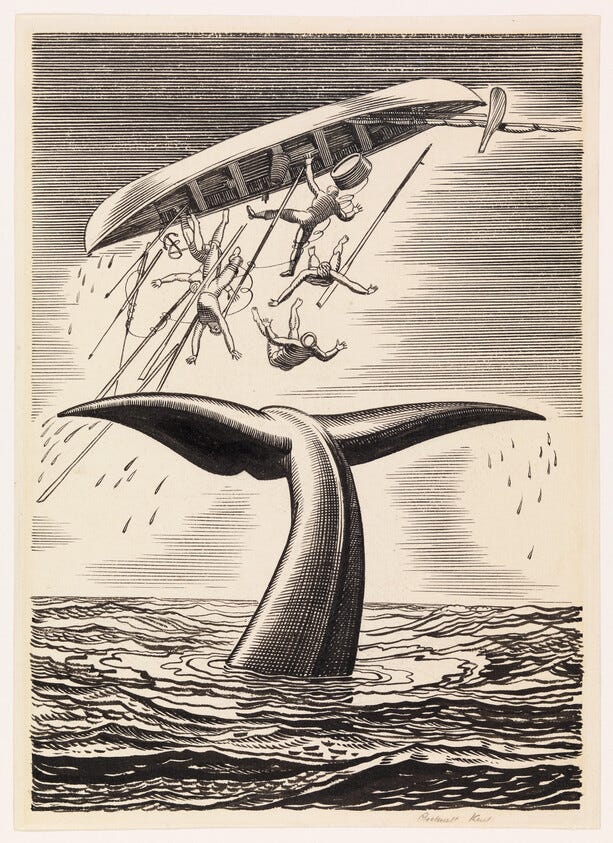
Ahab tries to fasten the harpoon to the whale, but the line fastens him instead. The physical knot does not create his bondage. It reveals it.
His final defiance sounds like complete sovereignty, but in fact it confesses dependence. He can die only in relation to the creature that has come to define him. The man who asks who stands over him disappears beneath the sea attached to the answer.
This returns us to Narcissus. Narcissus dies trying to possess the reflection in the water; Ahab dies bound to the creature upon whom he has projected his wounded self. One reaches for the image; the other attacks it. Both enter the water because they cannot allow the world to remain other.
Ishmael, by contrast, survives because he doesn’t master the whale or try to save himself purely by his own efforts. He receives life through Queequeg’s coffin, a searching ship and a providence he cannot command.
Paddy’s cry in Warrior therefore addresses every man whose pain has become a course, every father who has made his household inhabit his shame, every son who has built identity around opposition to his father, every husband who has made recognition the hidden end of marriage, and every leader who has turned a shared enterprise into the vehicle of a private wound.
“Stop the ship” doesn’t mean surrender every difficult mission. It means recover the difference between perseverance and compulsion, between a calling and an obsession, between a boundary and punishment, between leadership and control, between righteous anger and the need to make someone suffer.
The command may require another person to intervene. It may require a crew to refuse a captain, a friend to confront a friend, a wife to establish a boundary, a son to name an old wound, or a man to place himself under authority before his private disorder becomes everyone else’s fate.
But the deepest stopping must occur in the will. Ahab’s tragedy is not that he possesses too much strength but that he refuses every truth capable of governing it. His wound determines his purpose. His enemy determines his identity. His anger determines his justice. His pride determines his use of authority. His hatred determines his death.
Machismo promises freedom through refusal: no dependence, no correction, no superior measure, no vulnerability and no need to turn back. Yet it ends by binding the man to the injury against which he has defined himself.
Genuine masculinity accepts a harder freedom. It allows strength to be governed by truth, anger by justice, courage by prudence, authority by the common good, greatness by humility, and the self by a good it did not create.
Ahab can command sailors, challenge the heavens and die without begging, but he can’t stop the ship because he can’t submit to truth.
Main works referenced
Herman Melville, Moby-Dick; or, The Whale.
Thomas Aquinas, Summa Theologiae, especially I–II, Questions 1–5 and 49–54, and II–II, Questions 47–56, 57–122, 123–140, 129, 157, 161 and 162.
Thomas Aquinas, Quaestiones Disputatae de Malo (On Evil), especially Questions I, VIII and XII.
Friedrich Nietzsche, Beyond Good and Evil, especially Section 260.
Friedrich Nietzsche, Thus Spoke Zarathustra, especially “On Self-Overcoming.”
Friedrich Nietzsche, On the Genealogy of Morality, First Treatise, especially Sections 10–11.
Yvor Winters, “Herman Melville and the Problems of Moral Navigation,” in In Defense of Reason.
Bainard Cowan, “America Between Two Myths: Moby-Dick as Epic.”
Arthur Schopenhauer, The World as Will and Representation.
Walter Benjamin, “The Destructive Character.”
Søren Kierkegaard, The Sickness Unto Death.
Augustine, Confessions and The City of God.
René Girard, Violence and the Sacred.
Max Scheler, Ressentiment.
John A. McHugh and Charles J. Callan, Moral Theology: A Complete Course Based on St. Thomas Aquinas and the Best Modern Authorities.
consistently incredible writing